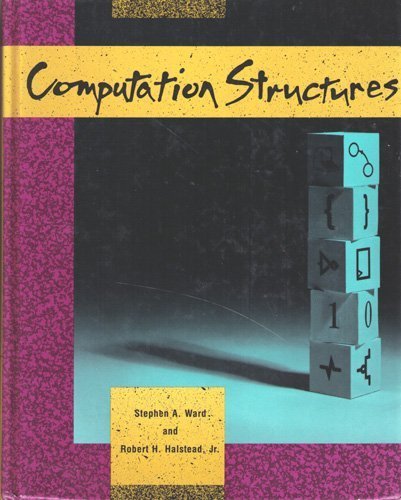
Computation Structures
ISBN: 0070681473
Found in 2 comments on Hacker News
We may earn a commission from purchases made through links on this page.
Not ready yet? Get weekly book picks.
p1esk
· 2026-05-23
·
Original thread
Here’s a great book explaining microprogramming from ground up: https://www.amazon.com/Computation-Structures-Optical-Electr...
Easy to find a free pdf
Get the best books from Hacker News each week
Join 4,500+ subscribers and get the best books mentioned on Hacker News every Thursday.

For a comprehensive answer, a good vintage introductory digital design textbook is Ward and Halstead's 1989 Computation Structures, from the "peak CISC" era! [1]
There, the second (vertical) type is often used for highly complex instructions/fancy addressing modes, that you might want to implement with some sort of procedure abstraction, loops, working memory, etc. A "luxury" vertical microcode engine would have facilities like "microprocedure calls", a micro-stack and workspace RAM, a micro-ALU, dispatch table micro-instructions. The authors use the suggestive term "interpretive microcode".
String instructions come to mind as a complex example; non-register machine architectures (stack machines); tagged data architectures that have instruction-level polymorphism (e.g. Lisp machines).
The culminating project of Ward and Halstead is an elaborate two-level microcode system (vertical on horizontal/second on first). I think the first Motorola 68k had this architecture -- here is the patent. [2]
It's genuinely a fun read. The "write an micro-interpreter for your CISC ISA" approach is hopelessly out of date now that we need pervasive microarchitectural parallelism, and have HDLs.
[1] https://www.amazon.com/Computation-Structures-Optical-Electr...
[2] https://patents.google.com/patent/EP0011412A1/en?inventor=Ha...